

Deed in Lieu of Foreclosure: How It Works and When to Use It in Indiana

Falling behind on your mortgage payments can feel overwhelming. A deed in lieu of foreclosure lets you give the property back to your lender, which may help you avoid Indiana's lengthy foreclosure process. 1 This guide explains how a deed in lieu works under Indiana law, when it makes sense, and what steps you need to take. 2
Key Takeaways
- A deed in lieu of foreclosure lets you voluntarily transfer your home to the lender when you cannot keep up with mortgage payments. It typically causes less credit damage—about 50–125 points—compared to 200–300 points for a full Indiana foreclosure. 3
- Indiana's judicial foreclosure process can take a year or longer. A deed in lieu typically resolves in 90–180 days and keeps the transaction out of public court records.
- You must prove financial hardship, attempt to sell first, have no major property damage or unresolved junior liens, and provide documentation such as tax returns and bank statements. FHA guidelines generally require at least 90 days of missed payments.
- Indiana is a recourse state, meaning lenders can pursue a deficiency judgment for up to ten years after the transfer. Always confirm in writing whether your agreement waives that right.
- Forgiven mortgage debt over $600 may be treated as taxable income under IRS Form 1099-C rules. Consult a real estate attorney or HUD-approved housing counselor before proceeding.
What Is a Deed in Lieu of Foreclosure?
A deed in lieu of foreclosure lets you transfer your home's title directly to the mortgage lender when you can no longer make payments. This voluntary agreement helps you avoid Indiana's judicial foreclosure process, which requires a court filing in the county circuit or superior court and can stretch well beyond a year. 1 Your lender accepts the property title subject to any existing claims or liens, including second mortgages or mechanic's liens.
If your lender approves, the arrangement typically releases you from further obligation on the mortgage debt unless a separate agreement says otherwise. Many lenders also offer moving assistance—sometimes called "cash for keys"—to ease your transition out of the property.
Unlike a formal foreclosure, a deed in lieu stays out of public court records and causes significantly less credit score damage. This option works best when both parties want to minimize loss: you avoid extended legal proceedings, and the lender gains control of the property faster than through Indiana's court-supervised foreclosure sale process.
Step-by-Step Process of a Deed in Lieu of Foreclosure
You can take clear steps to request a deed in lieu from your loan servicer in Indiana. Title searches, mortgage agreements, and fair market analyses play a key role throughout.
Identifying financial hardship and missed payments
Financial hardship often begins with missed mortgage payments. Most lenders require at least 90 days without a payment before they will consider a deed in lieu. Gather recent tax returns, pay stubs, and bank statements to demonstrate genuine hardship. If your loan is "underwater"—meaning you owe more than your home is worth in the current Indianapolis, Carmel, or Fishers market—that strengthens the case for lender approval.
Submit profit and loss statements if you are self-employed. The lender may also want evidence that your property was listed for sale for at least 90 days before agreeing to accept a deed in lieu.
Communicating with the lender
Reach out to your mortgage servicer as soon as you anticipate trouble. Put your request in writing, explaining why you cannot continue making payments and what terms you are seeking. The agreement must be voluntary and free from duress or fraud to be enforceable under Indiana law.
Ask your lender upfront whether a deed in lieu will discharge the full mortgage balance or whether a deficiency claim remains possible. Some Indiana lenders will only accept this option if no junior liens exist on the property. Expect the process to take between 90 and 180 days from application to completion.
Submitting an application
Collect all required documents before submitting to the loss mitigation department: a hardship letter, recent tax returns, bank statements, pay stubs, and a summary of monthly income and expenses. 2 Many lenders also require proof that you attempted to sell—such as a listing agreement or written buyer offers—before they will accept a deed in lieu. 1 Include a property value report from an appraiser or a Broker Price Opinion (BPO).
Property valuation and negotiation
Your lender will order a BPO or full appraisal to confirm the home's current market value against what you owe. If junior liens—such as a second mortgage, HELOC, or Indiana tax lien—remain unresolved, the lender will likely halt the process until those are cleared.
Negotiate settlement terms carefully. The written agreement should state whether the lender forgives the remaining mortgage balance or retains the right to seek a deficiency judgment. Indiana law gives lenders up to ten years to pursue a deficiency, so a written waiver is critical.
Signing the deed and transferring ownership
Closing typically takes place at a title company or attorney's office in Indiana. You voluntarily sign the deed over to the lender, who then records it with the county recorder's office, vesting title in the lender. Once recorded, your right to manage, rent, or sell the home ends.
If the lender agreed to forgive the remaining debt, they issue a satisfaction of mortgage. Review all closing documents with a qualified Indiana real estate attorney before signing, as errors can affect both your tax liability and your credit recovery timeline.
Deed in Lieu vs. Foreclosure: Key Differences
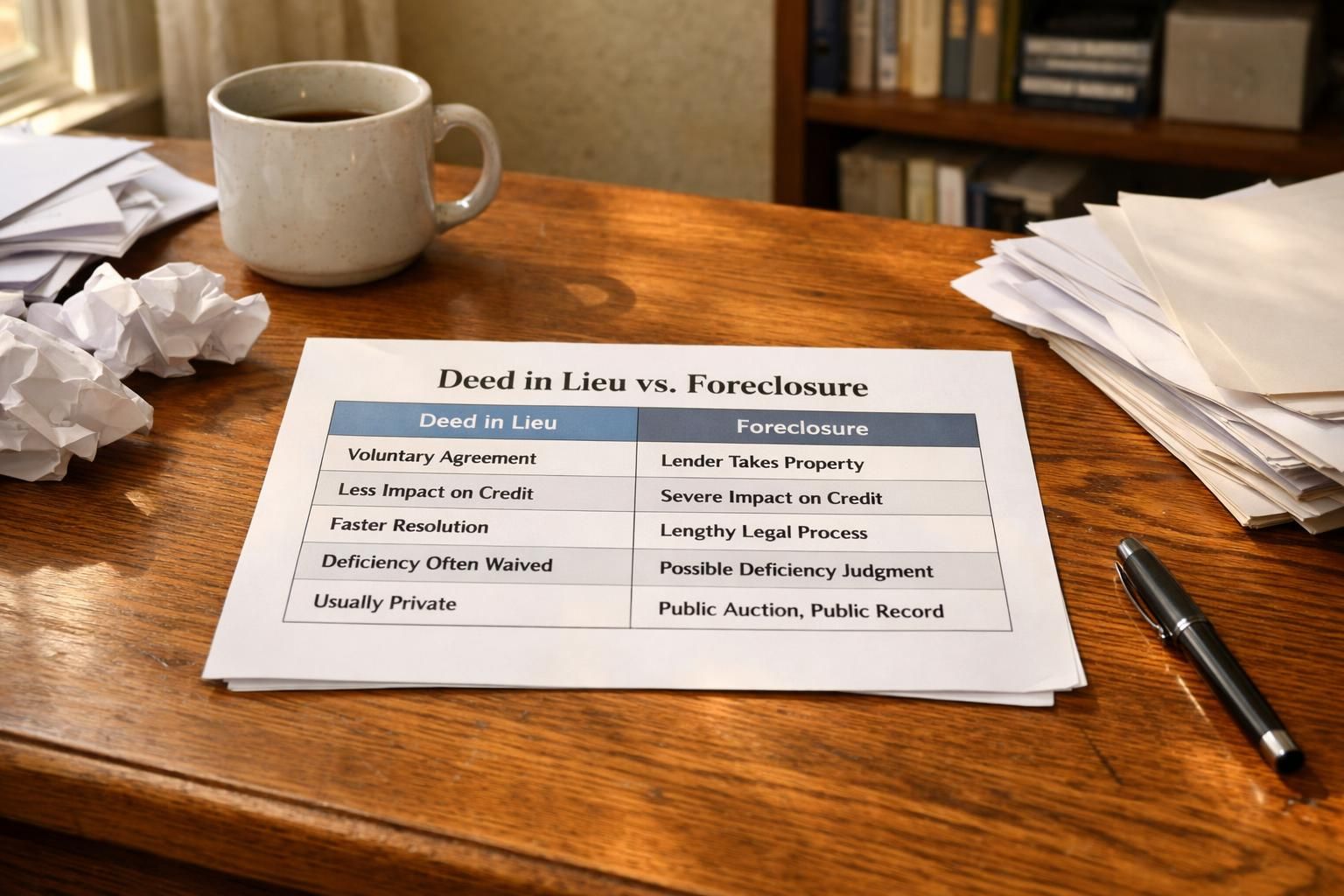
Credit score impact
A deed in lieu typically lowers your credit score by 50–125 points—far less than the 200–300 point drop from a full foreclosure. 3 A deed in lieu remains on your credit report for about four years, while a foreclosure stays visible for seven years. You may qualify for a new conventional loan in two to four years after a deed in lieu, versus a longer waiting period following foreclosure.
Timeline comparison
Indiana's judicial foreclosure process requires the lender to file a lawsuit in circuit or superior court, obtain a judgment, and conduct a sheriff's sale—a process that commonly takes 12 to 18 months or longer. A deed in lieu, by contrast, typically completes in 90 to 180 days without courtroom appearances, reducing stress and expense for both sides.
Deficiency judgment possibilities
Indiana is a recourse state. If your home sells for less than the outstanding mortgage balance, your lender may pursue the difference through a deficiency judgment. Indiana law allows creditors up to ten years to seek that judgment, though lenders less commonly do so in deed-in-lieu cases when the agreement includes a written waiver. Always demand a deficiency waiver in writing before signing over the deed.
Public record implications
Indiana foreclosures become part of the public court record, visible in county circuit or superior court filings and on your credit report for seven years. 3 A deed in lieu avoids that public exposure. Future landlords, employers, and lenders conducting background checks are far less likely to encounter a deed in lieu than a formal foreclosure judgment.
Eligibility Requirements for a Deed in Lieu of Foreclosure

To qualify in Indiana, you generally must: 4
- Demonstrate ongoing financial hardship with supporting documentation
- Have missed multiple mortgage payments (typically 90+ days)
- Show that loan modification or refinancing was attempted and failed
- Own a home with no significant property damage or unresolved code violations
- Hold clear title with no unresolved junior liens or unpaid property taxes
- Provide evidence the home was listed for sale—usually at least 90 days—without a buyer
Lenders will order a BPO or appraisal confirming current market value. Whether you are in Indianapolis, Noblesville, or Lebanon, the property must be in acceptable condition for the lender to take it back without major repair liability.
When to Consider and When to Avoid a Deed in Lieu

Consider a deed in lieu when your Indiana home is underwater, you have exhausted loan modification and short sale options, and you cannot afford ongoing payments. If the lender agrees to waive the deficiency judgment in writing, you can walk away without additional debt. A HUD-approved housing counselor can help you evaluate whether this fits your specific situation.
Avoid a deed in lieu if your property still has significant equity—selling it outright will put cash in your pocket rather than surrendering everything to the lender. Also steer clear if junior liens or unpaid Indiana property taxes remain unresolved, since most lenders will reject the application until those are cleared. Homeowners who qualify for FHA loan modification programs may fare better keeping their homes through adjusted payment plans. If other debts complicate matters, consult a Chapter 7 or Chapter 13 bankruptcy attorney before proceeding.
Deficiency Judgments and Tax Implications in Indiana
Because Indiana is a recourse state, lenders retain the right to pursue a deficiency judgment for the gap between your mortgage balance and the property's value after a deed in lieu. 5 Indiana law provides a ten-year window to seek that judgment. Always secure a written deficiency waiver in your settlement agreement before you sign the deed.
On the tax side, if your lender forgives more than $600 in mortgage debt, the IRS may treat that amount as taxable income and issue a Form 1099-C. The Mortgage Forgiveness Debt Relief Act has expired; certain exclusions—such as insolvency—may still apply. Consult a tax attorney familiar with Indiana and federal rules to understand your exact exposure before closing.
Indiana does not impose a state-level mortgage recording tax on deed-in-lieu transfers the same way some states do, but county recorder fees and transfer costs still apply. Document every step carefully; accurate records protect you during any future disputes with lenders or tax authorities.
Alternatives to Deed in Lieu of Foreclosure
Short sale
A short sale lets you sell your home for less than you owe, provided your lender approves. 6 You must submit a loss mitigation package including a hardship letter, financial statements, and proof of listing. Indiana lenders typically want the home listed for at least 90 days first. Confirm whether the lender will waive any deficiency in writing, and ask a tax professional whether forgiven debt will trigger a 1099-C.
Loan modification
Loan modification changes your mortgage terms—lowering the interest rate, extending the loan period, or establishing a forbearance arrangement. Lenders require hardship documentation before reviewing your application. Government-backed programs may be available depending on your loan type. A successful modification can prevent foreclosure entirely and limit credit score damage.
Forbearance
Forbearance temporarily pauses or reduces your payments during a short-term hardship such as job loss or illness. Plans typically last three to twelve months but do not cancel the missed amounts—you repay them later in a lump sum or repayment schedule. 7 If financial difficulties persist beyond the relief window, lenders may recommend modification or other alternatives.
Chapter 13 bankruptcy
Chapter 13 bankruptcy allows Indiana homeowners with regular income to stop foreclosure and repay mortgage debt through a court-approved three-to-five-year plan. While bankruptcy stays on your credit report for up to ten years, many homeowners find it easier to rebuild after Chapter 13 than after a completed foreclosure. Consult a licensed Indiana bankruptcy attorney before pursuing this path.
Selling to a cash buyer
Selling to a cash buyer can help you exit quickly—often within 7 to 14 days—without making repairs or waiting for mortgage approvals. The sale price may be below market value, but you sidestep further credit damage and possible deficiency judgment risk. 8 This works best when your home has meaningful equity to cover the mortgage balance. 9
Actionable Next Steps for Indiana Homeowners
- Contact your lender or loan servicer immediately when you miss a payment. Early outreach opens more options before Indiana's foreclosure process begins.
- Gather financial documents: recent pay stubs, two years of tax returns, bank statements, and a list of monthly expenses.
- Write a clear hardship letter describing your situation and why continued mortgage payments are not feasible.
- Ask about all foreclosure alternatives—loan modification, forbearance, short sale—before committing to any one option.
- Demand a written deficiency waiver. Indiana's ten-year recourse window makes this step especially important. 1
- Confirm the deed in lieu agreement covers your total mortgage debt before signing.
- Contact a HUD-approved housing counselor for free guidance. Indiana residents can find counselors through the HUD website.
- Consult a licensed Indiana real estate attorney familiar with foreclosure defense before agreeing to any settlement terms.
- Talk with a tax professional about potential 1099-C income and any available insolvency exclusions under federal rules.
- Evaluate any "cash for keys" relocation assistance offered by the lender.
- Keep copies of all communications, agreements, and signed documents. Accurate records protect you during any future disputes.
Conclusion
Facing the loss of your Indiana home is difficult, but a deed in lieu of foreclosure can provide meaningful relief compared to a drawn-out judicial foreclosure. Communicate early with your lender, get legal and tax advice, and carefully review every document before signing. Each situation is unique—weighing all your options gives you the best chance to protect your credit, your finances, and your family's future.
If you need to sell quickly and avoid foreclosure altogether, KDS Homebuyers buys Indiana homes directly for cash in any condition. Visit kdshomebuyers.net to request a free, no-obligation cash offer and explore your options today.
FAQs
1. What is a deed in lieu of foreclosure and how does it work in Indiana?
A deed in lieu lets an Indiana homeowner transfer the property title to the lender to settle mortgage debt and end the foreclosure process without a court-supervised sheriff's sale.
2. How does a deed in lieu compare with a short sale or loan modification in Indiana?
A loan modification adjusts payment terms so you keep your home. A short sale requires selling below the mortgage balance with lender approval. A deed in lieu transfers ownership directly to the lender when those options are not viable.
3. Will my credit score be affected?
Yes, but typically less than a full foreclosure—expect a drop of 50–125 points rather than 200–300. The entry stays on your credit report for about four years versus seven for a formal foreclosure.
4. Can I use a deed in lieu if I have a second mortgage?
Junior lienholders must agree to release their claims. Most Indiana lenders will not accept a deed in lieu if unresolved junior liens remain on the title.
5. Should I get legal advice before accepting a deed in lieu offer?
Yes. An Indiana real estate attorney can review deficiency judgment risks, and a tax professional can clarify whether forgiven debt creates taxable income under current IRS rules.
References
- ^ https://www.consumerfinance.gov/ask-cfpb/what-is-a-deed-in-lieu-of-foreclosure-en-291/
- ^ https://www.nar.realtor/financing-credit/deed-in-lieu-of-foreclosure
- ^ https://residentialequitypartners.com/foreclosure-vs-deed-in-lieu-which-is-the-better-option/
- ^ https://www.nycbar.org/get-legal-help/article/real-property-law/residential-mortgage-loan-foreclosure-in-new-york/deed-in-lieu/
- ^ https://academic.oup.com/rfs/article/24/9/3139/1571250?login=true
- ^ https://www.nolo.com/legal-encyclopedia/deed-lieu-vs-short-sale.html
- ^ https://www.huduser.gov/portal/Publications/pdf/alt.pdf
- ^ https://scholarship.law.upenn.edu/cgi/viewcontent.cgi?article=1410&context=jbl
- ^ https://www.justia.com/foreclosure/alternatives-to-foreclosure/short-sales-and-deeds-in-lieu-of-foreclosure/
